
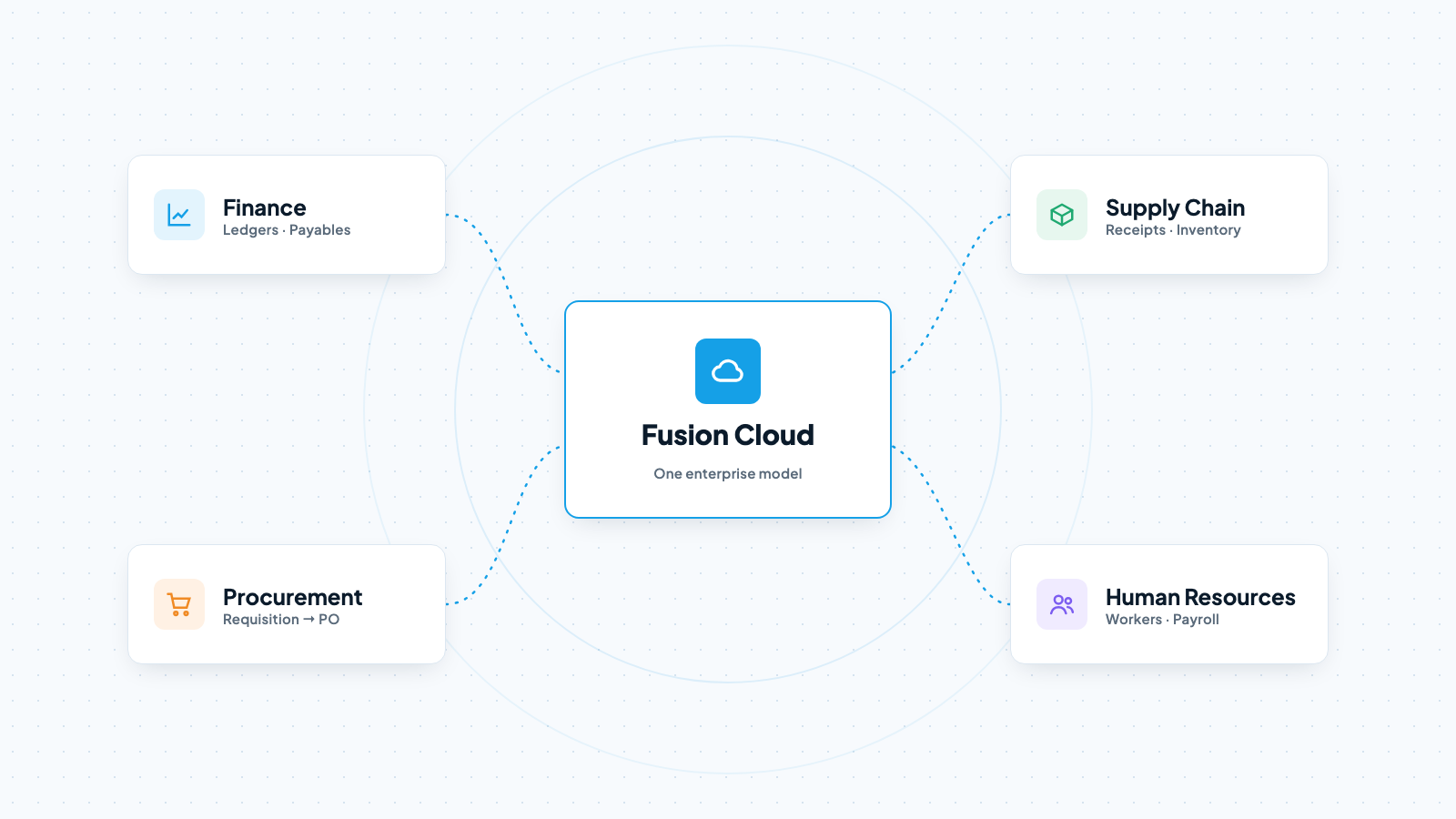
An invoice can pass every technical integration check and still arrive in the wrong business unit. That is the kind of problem that makes Oracle Fusion Cloud Applications implementation a business design exercise. Across finance, procurement, supply chain, and human resources, the quality of foundational decisions determines whether transactions move cleanly through the enterprise. A service partner needs to understand those dependencies before configuration begins.
Start with the enterprise model
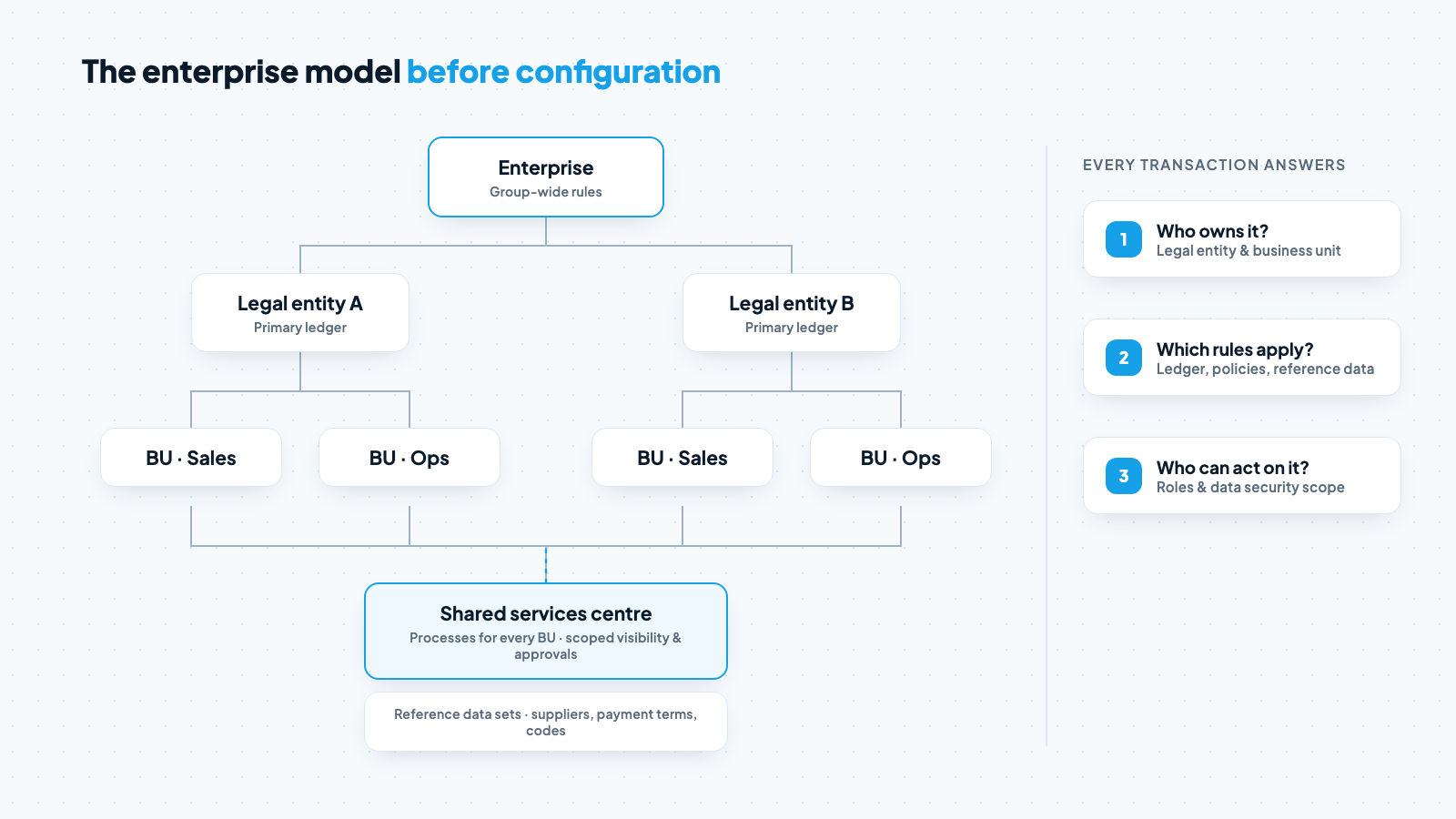
Legal entities, ledgers, business units, and reference data sets serve different purposes. Treating them as interchangeable can create problems with accounting, operational ownership, reporting, and access. A shared services operation, for example, may process transactions for several entities while requiring carefully defined visibility and approval responsibilities. The design should explain who owns a transaction, which rules apply, and who can act on it. Explore Oracle's enterprise structure guidance.
Process workshops should therefore follow complete business scenarios. For procure to pay, trace a requisition through approval, purchase order, receipt, invoice, and payment. Include exceptions such as a changed supplier bank account or an invoice without a matching receipt. These scenarios expose decisions that a module checklist can miss.
- 1Requisition
Which business unit raises it?
- 2Approval
Who approves, and who covers when they are away?
- 3Purchase order
Which rules and supplier data apply?
- 4Receipt
What happens when nothing is received?
- 5Invoice
How are mismatches routed and owned?
- 6Payment
Is a changed bank account verified first?
Design the handoffs and controls
Integration needs the same attention to business meaning. Whether a requirement uses an application programming interface or a supported bulk import, define the authoritative source, validation rules, processing frequency, and reconciliation method. A successful transmission does not prove that the receiving application accepted and accounted for every record. Rejected transactions need an owner and a controlled route back into processing.
Security should be tested alongside those handoffs. Access to a function and access to the underlying business data are separate questions. Test realistic combinations of responsibilities and organizational scope, including temporary cover and shared services roles. Reporting also needs reconciliation: an operational dashboard and a financial statement may answer different questions because they use different transaction states or accounting dates.
Migration should rehearse those same business scenarios. Reconcile opening balances and open transactions, then verify that converted suppliers, workers, and organizational assignments support subsequent processing. Keep a record of transformation rules so finance and HR can explain how legacy values became Fusion values. Repeating the rehearsal with corrected data gives a stronger basis for cutover than relying on record counts from one successful load.
Make change part of the operating model
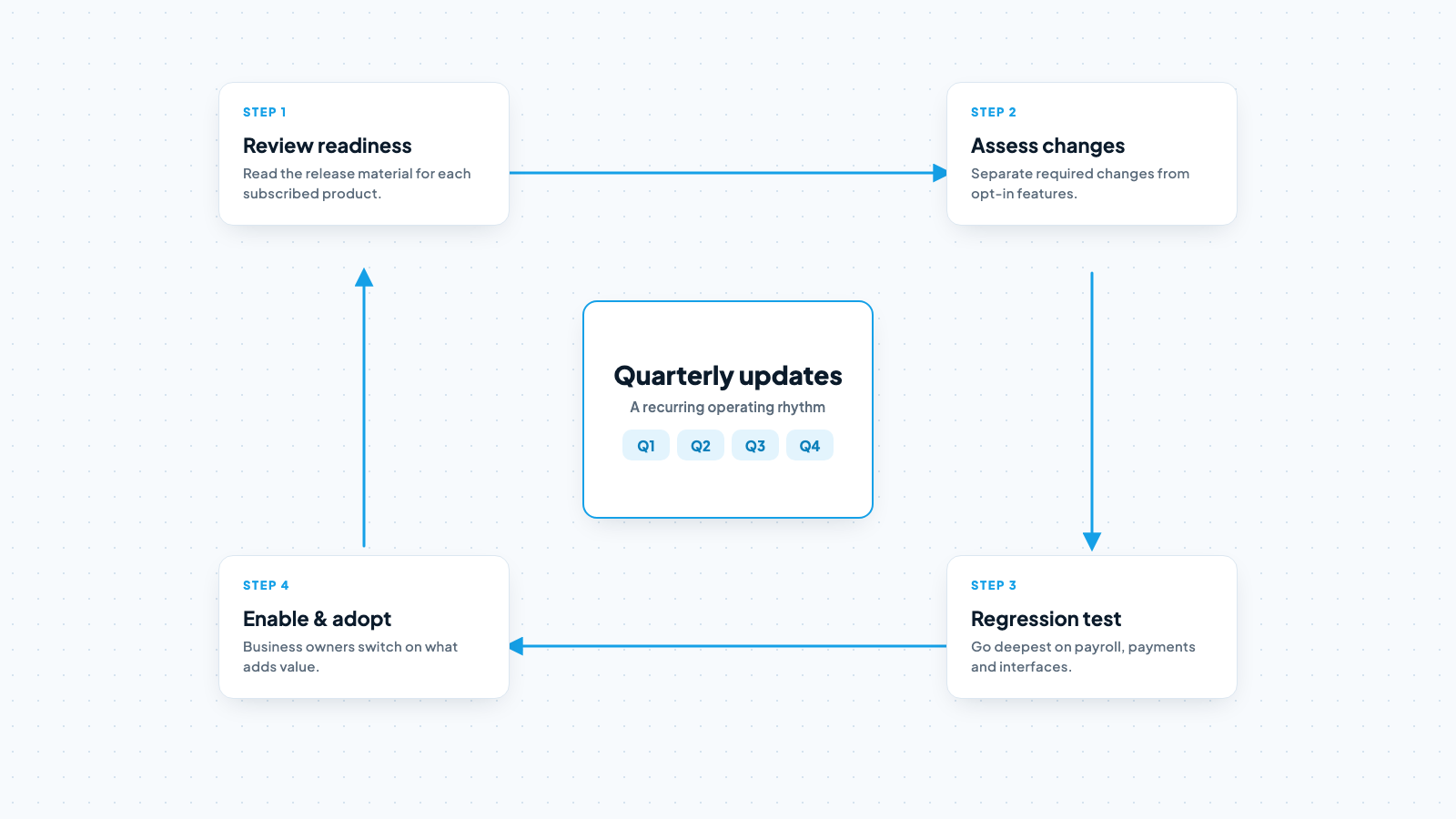
Oracle delivers quarterly updates across the core Fusion Applications suite. Customers need a recurring process for reviewing readiness material, assessing applicable changes, and testing their configured workflows. Update planning should distinguish required changes from features that need enablement, using the guidance for the subscribed product. A payroll interface or payment process deserves deeper regression coverage than a rarely used screen. Plan your next release with Oracle's quarterly update guidance.
Adoption continues after deployment. Assign business owners to evaluate useful features, maintain training as processes change, and measure outcomes such as invoice exceptions or approval delays. Extensions should have a documented business purpose and a maintenance owner. The strongest implementation leaves behind a team that can explain its design and manage the next change. For a services organization, that continuing operational discipline is central to delivering value from Fusion Cloud Applications.