

1. Two Teams, One Deadline
It's the final week before a major product launch. On one side, Team No‑Code—business analysts armed with drag‑and‑drop AI builders—are racing to prototype an automated ECO routing workflow. On the other, Team Low‑Code—software engineers wielding Python and Node.js—are deep in the weeds writing custom integrations for PLM and ERP. Both groups face the same goal: deliver an AI‑driven workflow that slashes change‑order cycle times. But whose approach will win the ROI battle?
2. The Stakes: Speed, Flexibility, and Cost
Choosing between no‑code and low‑code isn't simply a technical decision—it's strategic:
- Time‑to‑Value: How fast can you go from idea to production?
- Scalability: Will the solution handle thousands of change orders and complex validations?
- Maintainability: Can non‑technical staff update workflows, or will you need developers for every tweak?
- Integration Depth: Do you need deep hooks into legacy APIs, custom ML models, or dynamic data transformations?
- Total Cost: Consider platform licensing, developer salaries, and ongoing maintenance.
Let's break down the two contenders:

3. A Real‑World Showdown
Scenario: Automating ECO Routing for a Medical Device Firm
Objective: Route ECOs based on part criticality, supplier region, and regulatory risk.
Volume: 500 change orders per month.
Systems: Windchill PLM, SAP ERP, ServiceNow, Teams.
Team No‑Code Workflow (Prototype Phase):
-
Trigger: Webhook in a no‑code studio catches new ECO in Windchill.
-
Decision Block: Business rule configured visually to classify "High," "Medium," or "Low" risk.
-
Action Blocks: ○ Low → Email notification ○ Medium → Teams message ○ High → ServiceNow ticket
-
Timer: Escalate after 8 hours via SMS.
Time to Prototype: 3 days Initial Savings (Manual Touchpoints): 40%
Team Low‑Code Workflow (Build Phase):
-
API Integration Module: Custom Python service queries Windchill metadata, computes risk scores via a machine‑learning model, and writes back to PLM.
-
Queue Orchestrator: Node.js app pushes tasks to RabbitMQ, with dynamic routing logic defined in code.
-
Notification Service: Custom scripts send templated messages via email, Teams, and SMS, pulling real‑time SLA data from SAP.
-
Dashboard: React‑based UI shows live metrics, built from scratch.
Time to Production: 8 weeks Projected Savings (Year One): $350K
4. The Hybrid Knockout Approach
The sweet spot? Combine no‑code speed with low‑code depth:
- Prototype Rapidly: Use no‑code to build the initial workflow and validate business rules with stakeholders.
- Identify Gaps: Pinpoint areas requiring custom logic—complex data transformations, ML predictions, advanced error handling.
- Inject Low‑Code Hooks: Drop in Python/JavaScript modules where needed, called directly from the no‑code designer.
- Wrap with Orchestration: Build a lightweight orchestrator service that manages agents, retries, and version control.
- Govern & Secure: Apply API gateways, RBAC, and audit logging across both no‑code flows and custom code.
By blending the two, you get the speed of no‑code and the power of low‑code—delivering robust, scalable solutions in a fraction of the time.
5. Under the Hood: Architecting the Hybrid Model
A. No‑Code Core
- Platform Choice: Select a no‑code/low‑code platform with native support for custom code blocks (e.g., Microsoft Power Automate with Azure Functions, or n8n with custom node support).
- Core Flows: Build the primary data‑flow pipelines visually—event listeners, conditionals, notifications, and basic transformations.
B. Low‑Code Extensions
- Microservices: Host Python/Node.js services in Docker containers or Azure Functions.
- Function Registry: Expose these services as callable endpoints, secured via API keys or OAuth.
- Code Blocks in Designer: Use the platform's "run script" nodes to call your microservices, passing serialized JSON payloads.
C. Orchestration Layer
- Task Scheduler: Use a central orchestrator (e.g., Prefect, Apache Airflow, or a custom Node.js service) to manage workflow runs, retries, and error handling.
- Event Bus: Leverage Kafka or Azure Event Grid for high‑throughput event streaming between agents.
- Monitoring & Logging:
- No‑Code Platform Logs: Capture execution logs from the no‑code studio.
- Microservice Logs: Stream to ELK or Grafana via Prometheus.
- Unified Dashboard: Aggregate metrics—cycle times, error rates, throughput—in Power BI or Grafana.
D. Security & Governance
- API Gateway: Kong or Azure API Management to secure and version your microservices.
- RBAC: Enforce role‑based permissions in your no‑code designer and microservices.
- Audit Trails: Immutable logs for every decision point, stored in a tamper‑proof data store.
6. Case Study: Hybrid Success at a Tier‑1 OEM
A global automotive manufacturer engaged TEKNIKOZ to slash their average ECO cycle from 14 days to under 5:
- Phase 1 (No‑Code Prototype): Delivered a working ECO listener and basic routing flow in 4 days—validated by stakeholders.
- Phase 2 (Low‑Code Enhancements): Added a Python‑based risk‑scoring microservice and real‑time supplier SLA checks in 3 weeks.
- Phase 3 (Orchestration & Scale): Rolled out to six business units, integrated with Kafka for event streaming, and configured Prometheus/Grafana for monitoring.
Outcomes in Year One:
- Cycle Time: 65% reduction, from 14 days to 5 days
- Operational Savings: $450K in labor and delay costs
- Error Rate: 80% fewer routing mistakes and missed approvals
7. Decision Matrix: When to Use Which
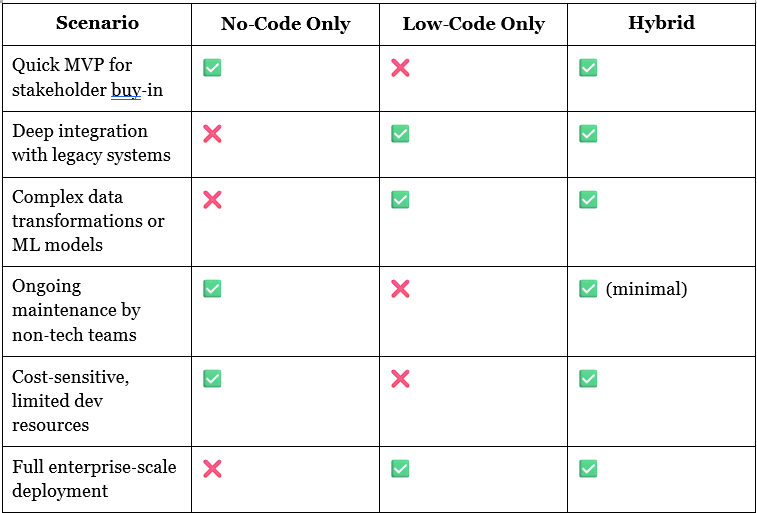
Choose No‑Code When:
- Rapid prototyping is critical
- Business users need to maintain workflows
- Standard integrations suffice
- Budget is constrained
- Speed trumps complexity
Choose Low‑Code When:
- Complex business logic is required
- Custom integrations are needed
- Performance is critical
- Advanced security is required
- Long‑term scalability matters
Choose Hybrid When:
- You need both speed and flexibility
- Multiple stakeholders are involved
- Governance and compliance are crucial
- Enterprise‑grade scale is required
- ROI optimization is paramount
8. Strategic Roadmap: Your Path to ROI
- Discovery Workshop (Week 0): Identify top three engineering workflows ripe for automation.
- No‑Code Sprint (Weeks 1–2): Build MVPs, gather user feedback, and refine logic.
- Low‑Code Build (Weeks 3–4): Develop custom microservices for identified gaps.
- Integration & Orchestration (Weeks 5–6): Spin up orchestrator, connect event bus, and configure monitoring.
- Pilot & Iterate (Weeks 7–8): Roll out to pilot group, measure KPIs, and tune.
- Scale & Govern (Months 3+): Expand across global sites, enforce governance, and maintain a continuous improvement loop.
9. Key Takeaways
- Blend Speed and Power: No‑code delivers prototypes; low‑code delivers depth.
- Maximize ROI: Rapid experimentation followed by targeted engineering avoids wasted effort.
- Ensure Reliability: Orchestration and monitoring are non‑negotiable for enterprise scale.
- Empower Teams: Business users manage flows; developers focus on innovation.
10. Your Next Step: The Hybrid AI Accelerator
Ready to win the ultimate ROI face‑off?
👉 Schedule your "Hybrid AI Accelerator" session with TEKNIKOZ. In two weeks, you'll have:
- Three fully functional no‑code prototypes
- Two custom low‑code microservices integrated
- A production‑ready orchestration blueprint
- A detailed ROI forecast
Stop choosing between speed and flexibility. Get both—today.
Ready to win the ultimate ROI face‑off? Schedule your 'Hybrid AI Accelerator' session with TEKNIKOZ.