
A production supervisor needs to know whether a material receipt has posted, whether it failed validation, and what to do next. That operational certainty should guide automation in Oracle JD Edwards. For EnterpriseOne environments, Orchestrator offers a practical way to connect business processes with external systems and automate repetitive activity. The services challenge is to make those automations dependable under the conditions of a real plant, warehouse, or finance operation.
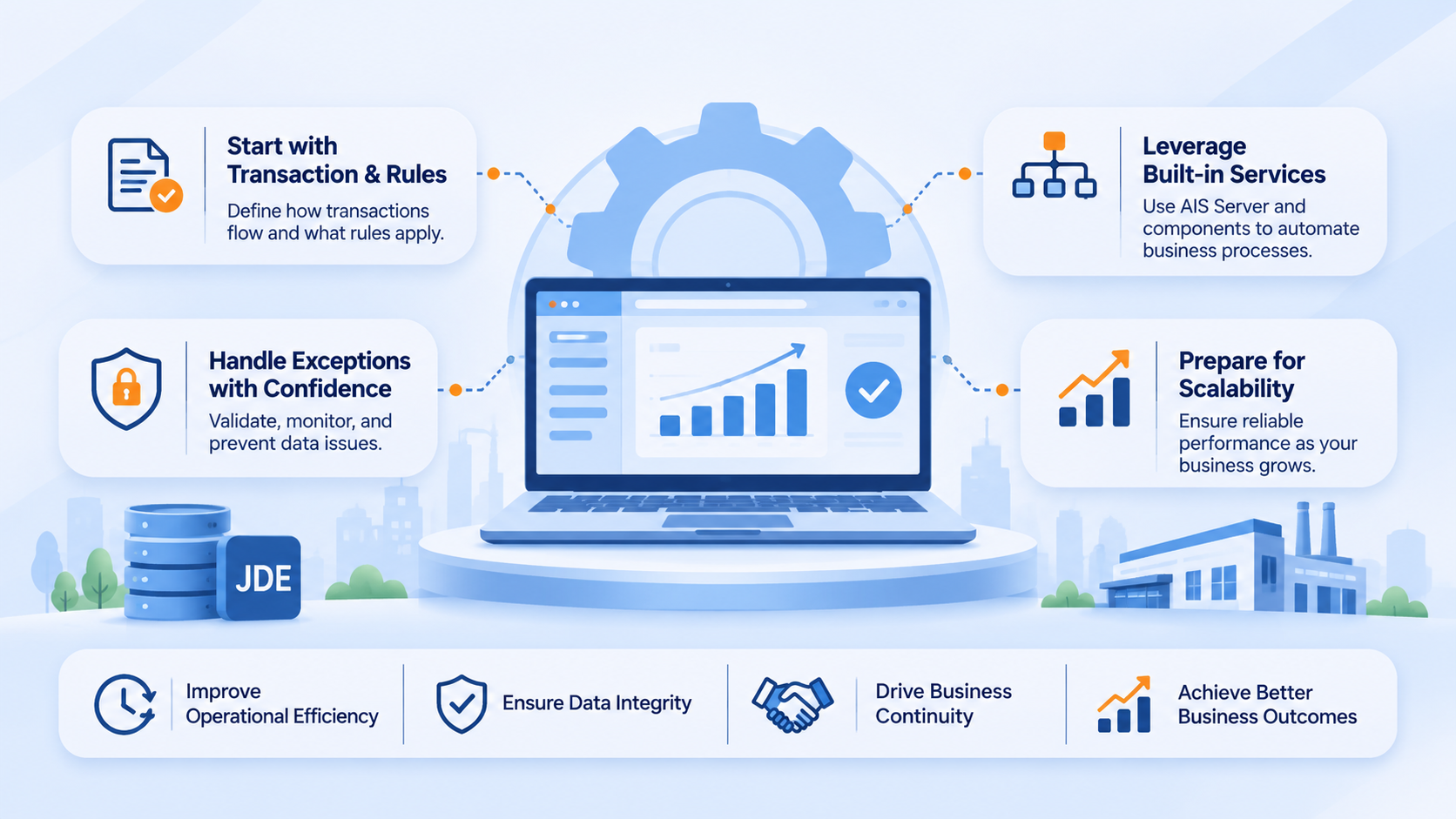
Begin with the transaction and its rules
An automation should start with a well-understood EnterpriseOne transaction. Document the required master data, processing options, application versions, and security before designing the interface. An item code, branch or plant, and unit of measure can each change how a transaction behaves. Passing a structurally valid message is insufficient if those business assumptions are wrong.
Orchestrations run through the EnterpriseOne Application Interface Services server, commonly called the AIS Server. They can combine service requests with rules and other components to perform business activity. This makes it possible to connect an external event to an EnterpriseOne process, but it also introduces dependencies that should be mapped and supported. Confirm the required capabilities against the installed Tools release. Explore Orchestrator components and AIS execution.
Engineer the exception path
Consider a warehouse scanner sending a receipt confirmation. The design needs to handle an unknown item, a closed purchase order, and a network timeout after submission. That last case is especially important: a timeout may leave the sender uncertain even when the receiving transaction succeeded. Blindly retrying can create duplicates. Use a business reference or another suitable control to detect prior processing before submitting again.
- 1Scanner sends receipt
Carries a business reference
- 2Validate
Unknown item or closed purchase order?
- 3Submit to EnterpriseOne
Through an orchestration on the AIS Server
- 4Timeout?
The receipt may still have posted
- 5Check before retrying
Look up the reference to avoid a duplicate
Separate validation failures from temporary technical failures. Operations staff may be able to correct missing master data, while infrastructure teams investigate connectivity. Define which errors can be retried, who approves a correction, and what evidence confirms completion. Monitoring should connect orchestration exceptions with their business impact, such as an unposted receipt that prevents inventory from becoming available.
Validation failures
- Missing or wrong master data
- Operations staff correct the data
- Resubmit once the cause is fixed
Temporary technical failures
- Timeouts and connectivity problems
- Infrastructure teams investigate
- Retry only after checking for prior processing
Quantity precision and unit conversions deserve explicit test cases. Compare the source quantity, the quantity accepted by EnterpriseOne, and the resulting inventory movement. This is especially useful when devices and applications represent the same material using different units.
Treat automation as a supported asset
Orchestrations and related user defined objects need controlled promotion, access management, and ownership. Store the design, input contract, dependencies, and recovery instructions together. Use appropriately restricted integration identities and validate access in the target environment. A demonstration built with broad administrator rights can conceal permissions problems that appear only after deployment. Use Oracle's Orchestrator guide to plan deployment and support.
Performance testing should reflect production activity and timing. A flow that works for one transaction may compete with batch reports, scheduled jobs, or many concurrent devices. Measure processing time and queue behavior, and decide how the business will operate if the integration is temporarily unavailable. EnterpriseOne application maintenance and Tools changes should trigger focused regression of affected automations.
This discussion concerns JD Edwards EnterpriseOne; JD Edwards World requires its own architectural assessment. For EnterpriseOne customers, a services partner demonstrates expertise by delivering an automation that operations can trust, trace, and recover. That is what turns a useful prototype into a durable improvement to daily work.