
Growth can expose weaknesses in an ERP design long before transaction volumes become large. A new subsidiary, an overseas warehouse, or an acquisition may reveal that the original configuration no longer matches how the company operates. Oracle NetSuite can support an expanding business, but the implementation needs a deliberate approach to entity structure, accounting controls, and extensions. Those foundations deserve attention even when the initial deployment is small.
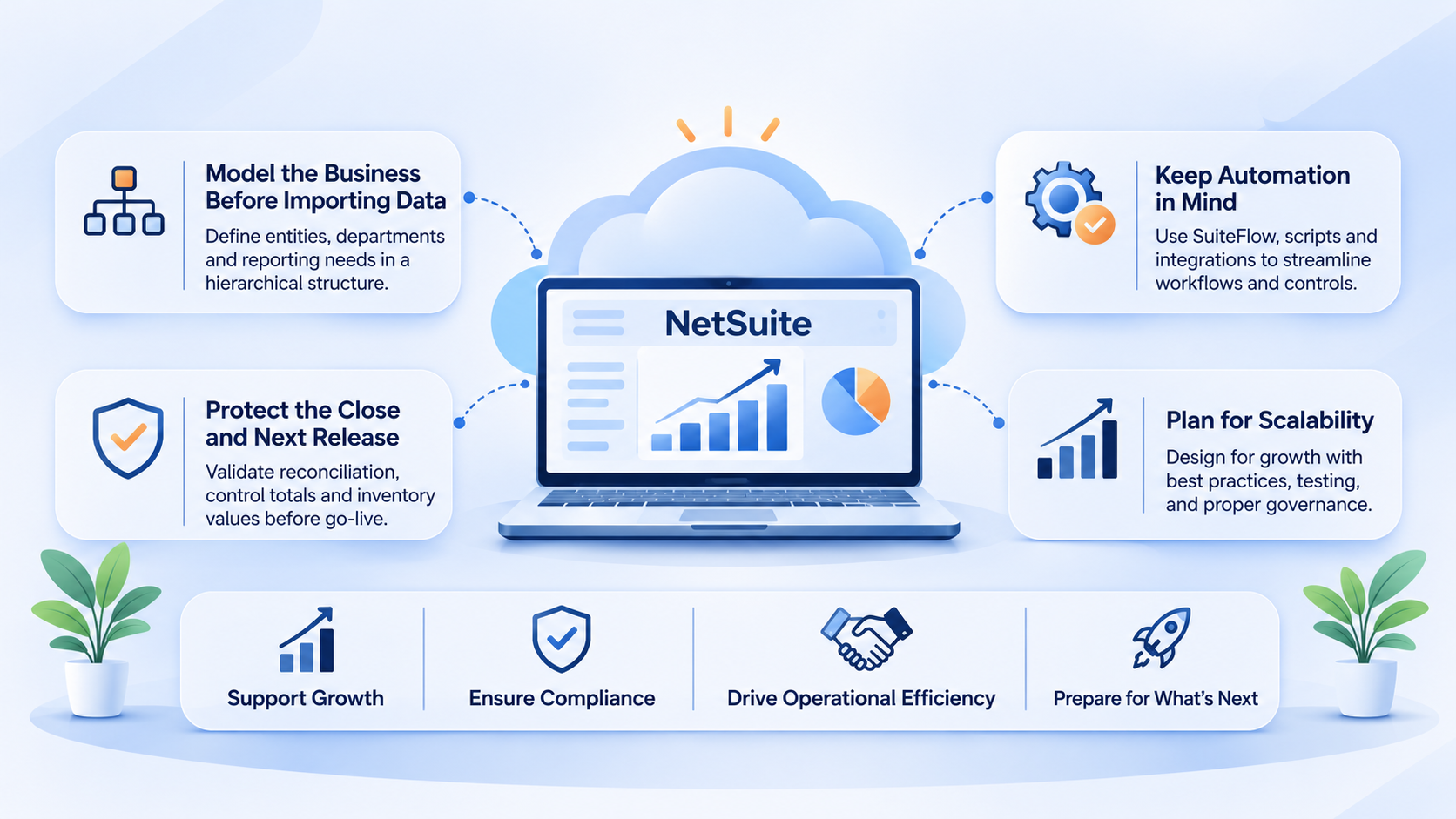
Model the business before importing data
In NetSuite OneWorld, subsidiaries represent separate legal entities within a hierarchy. Departments, locations, and other reporting classifications answer different questions. Using a subsidiary to represent an internal management division can complicate transactions and consolidation. Finance and operations should agree which structures reflect legal ownership and which support management reporting, then test that model against likely expansion scenarios. Review Oracle's OneWorld subsidiary guidance before finalizing your entity model.
Subsidiaries
- Separate legal entities
- Drive currencies, tax and consolidation
- Changing them later is costly
Departments, locations and classes
- Management and operational reporting
- Divisions, sites and product lines
- Can evolve as the business changes
Multi-entity design also needs clear decisions about currencies, intercompany activity, and elimination requirements. Work through a complete example in which one entity sells to another and the group reports consolidated results. Decide how transactions will be matched and how differences will be investigated. Tax configuration and local requirements need their own validation rather than assumptions based on another country's implementation.
- 1Entity A sells
Which currency and tax rules apply?
- 2Entity B buys
How is the matching purchase recorded?
- 3Match
How are the two sides paired?
- 4Investigate
Who owns any difference?
- 5Eliminate and consolidate
Do group results reconcile?
Keep automation within platform constraints
NetSuite's SuiteCloud capabilities provide ways to adapt workflows and extend application behavior. Each proposed extension should first be compared with standard configuration and the available functionality in the subscribed account. A small approval requirement may need a different solution from a complex external order integration. The design should make that choice explicit and identify who will maintain it.
SuiteScript operates within governance and execution limits. A script that handles a few test records may fail under a large import or a busy trading period. Developers should estimate usage, choose a suitable processing pattern, and test realistic volumes. Integration design also needs stable external identifiers, duplicate prevention, and controlled retries. Replaying an order message must not quietly create a second commercial transaction. Check SuiteScript governance and execution limits before scaling your automation.
Protect the close and the next release
Data migration should be judged by reconciliation. Opening balances, outstanding receivables and payables, inventory quantities, and inventory values need agreed control totals. Where historical detail is retained elsewhere, define how users will retrieve it. A technically successful load is incomplete until the business can explain the resulting balances and continue processing from them.
Role design should be tested with the same care as balances. Confirm that users can complete their tasks within the intended subsidiaries and that approvals still operate when a colleague is absent. Include reports and saved searches in access reviews because information can be exposed through more than transaction entry.
NetSuite Release Preview provides an opportunity to validate existing business workflows against an upcoming release. Include installed SuiteApps, scripts, integrations, and critical reports in that testing. Assign business users to confirm the outcomes that matter to them, such as billing accuracy or consolidation results, and give defects a clear resolution path. Prepare your test cycle with Oracle's Release Preview overview.
For a services partner, a successful NetSuite engagement should leave the customer with a coherent entity model, accountable process owners, and automation that remains reliable as activity grows. A useful measure is whether the next acquisition or new market can be absorbed without rebuilding the original design.