
1. Morning Mayhem: A Day in the Life of Elena, Systems Engineer
Elena's alarm rings at 6:30 AM. By 7:45 AM, she's already fielding Slack pings, hunting through Windchill for the latest ECO, and toggling between five browser tabs: one for SAP, another for the supplier portal, a third for email, plus Teams and her no‑code studio. Every day starts the same: fragmented tools, fractured data, and an endless loop of "Who's got the latest spec?" and "Did you sign off on this change?"
Three hours in, a supplier calls demanding updated drawings. The document Elena sent last night "didn't go through." She resends, follows up, and then gets pulled into a design review—only to discover the BOM on her screen is out of sync with ERP. The result? Two days of rework, frustrated stakeholders, and an under‑noticed opportunity cost: each day of delay costs their division roughly $250K in deferred revenue.
This scenario isn't unique. Across industries—automotive, aerospace, medical devices—teams battle the same tool sprawl: PLM for design, ERP for procurement, helpdesk for support, bespoke portals for suppliers. Data is locked in silos, and human handoffs are the glue that supposedly holds it all together. But the cracks show in miscommunications, redundant work, and delayed launches.
2. The Hidden Toll of Siloed Workflows
Before we dive into the cure, let's quantify the disease:
- Approval Delays: On average, manual change‑order approvals take 5–8 days per request and each day adds a compound delay across development, sourcing, and production.
- Context Gaps: According to a recent IDC study, knowledge workers spend 9.5 hours per week searching for information spread across multiple applications.
- Rework Costs: Product development teams report 15–20% of their time is spent on rework caused by data mismatches and outdated documents.
- Tool Switching Overhead: Engineers switch apps every 52 seconds, losing up to 23 minutes per day in context switching.
Multiply these inefficiencies across dozens of change orders, hundreds of parts, and multiple global sites—and the true cost is staggering. CEOs see slipping time‑to‑market, CFOs see margin erosion, and CIOs scramble to integrate ever more tools. Yet typical IT projects take months, require heavy development, and still leave gaps in governance and visibility.
3. Autonomous Agents: From Concept to Reality
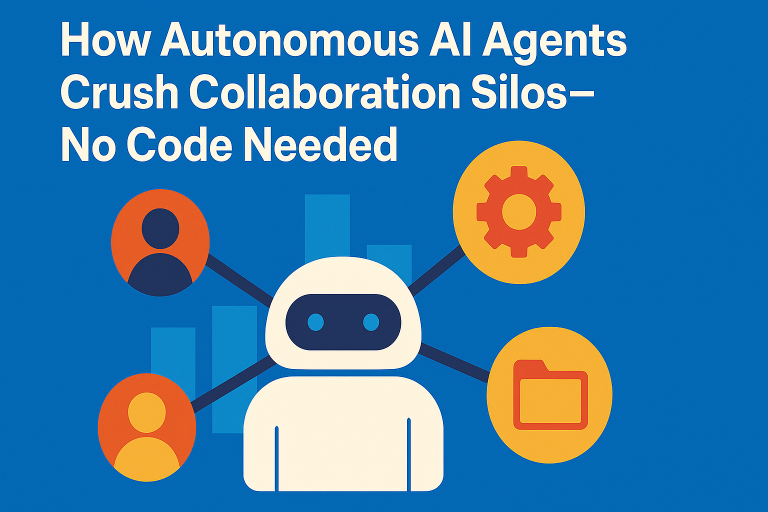
What if you could replace those manual chases with autonomous digital teammates—self‑driving workflows that:
- Detect events (e.g., a new ECO in Windchill)
- Extract relevant data (BOM, tolerance specs, supplier contact)
- Decide based on your business rules (risk levels, part criticality)
- Act—route approvals, update systems, send notifications
- Report outcomes and metrics to a unified dashboard
Better yet, you could build and deploy these agents without writing a single line of code.
4. Rapid Prototyping with No‑Code Studios
No‑code platforms like Make.com, Microsoft Power Automate, and n8n have matured beyond simple task automation. They now support robust enterprise integrations:
- Event Listeners: Watch for new records or file uploads in Windchill, SharePoint, or custom repositories.
- Conditional Logic: Build "if‑then" branches via intuitive dropdowns—no syntax errors or debugging needed.
- Pre‑built Connectors: Tap into REST APIs for SAP, Oracle, ServiceNow, or any OData endpoint.
- Visual Mapping: Transform and normalize data (e.g., map "Part_ID" to "ItemCode" automatically).
- Orchestration & Scheduling: Chain multiple actions and schedule runs with enterprise‑grade reliability.
Example Scenario: In an afternoon workshop, a cross‑functional team—business analysts, system architects, and a TEKNIKOZ consultant—built a "Change Listener Agent" that:
- Listens for new ECOs in Windchill via its webhook interface.
- Retrieves part details (material, tolerance) using a no‑code HTTP GET block.
- Runs a simple tolerance check (configured via a visual "Condition" module).
- Routes clean requests to an approval channel in Slack; flags exceptions to a quality‑control group.
- Logs every action in an Azure Table for audit and traceability.
By day's end, they had a working pipeline that would have taken weeks using traditional development. And because it's in a governed platform with role‑based access, IT leaders could oversee and manage it without hand‑coding security or compliance controls.
5. Deep Dive: Injecting Custom Logic with Low‑Code Hooks
No‑code solves 80% of standard workflows—but complex business logic often demands custom scripts. That's where low‑code hooks shine. Within the same visual flow, you can drop in:
- Python or JavaScript snippets to call legacy SOAP services.
- Custom modules to parse CAD metadata, compute geometric tolerances, or run ML‑based anomaly detection.
- Reusable libraries for tasks like PDF generation, email templating, or secure key management.
JavaScript Low‑Code Hook: Dynamic Escalation Logic
const { partId, tolerance } = inputData;
if (tolerance > SPEC_LIMITS[partId]) {
  // Raise an exception and notify QC team
  await notifyGroup('qc-team', `Part ${partId} exceeds tolerance: ${tolerance}`);
  throw new Error('Tolerance check failed');
}
// Otherwise, proceed
return { status: 'passed' };
This hybrid approach—no‑code for orchestration, low‑code for specialized logic—gives you the flexibility to automate every use case, from simple notifications to complex, multi‑system validations.
6. Scaling Up: Orchestration, Monitoring & Governance
When you outgrow a handful of prototypes, you need an enterprise‑grade architecture:
- Agent API Layer: Wrap your no‑code flows in RESTful endpoints so any system—code or no‑code—can trigger them.
- Central Orchestrator: A lightweight Node.js or Python service that registers agents, manages task queues (using Redis or RabbitMQ), and enforces retry policies.
- Event Bus: Use Kafka or Azure Event Grid to decouple agents and ensure high‑volume resilience.
- Monitoring & Logs: Emit structured events (JSON) at each handoff. Ingest into the ELK stack or Grafana via Prometheus exporters.
- Governance Controls: Apply role‑based permissions, data encryption, API throttling, and audit logging natively in the no‑code platform or via an API gateway (e.g., Kong).
This layered design keeps your system modular—agents can be updated individually, new ones spun up on demand, and governance policies enforced centrally.
7. Mini Case Studies: Diverse Industries, Similar Wins
- Medical Device Maker: Deployed an agentic pipeline for design‑change notifications, syncing Windchill to Oracle Agile. Result: 60% faster change implementation, zero missed compliance alerts.
- Aerospace Supplier: Built a no‑code/low‑code hybrid to validate CAD tolerances and auto‑generate inspection reports. Outcome: 50% reduction in inspection cycle time, 20% lower scrap rates.
- Heavy Equipment OEM: Orchestrated multi‑agent workflows for field‑service dispatch—combining digital twin data with support ticket systems. Achieved 40% decrease in downtime and launched a new premium support revenue stream.
8. Strategic Takeaways & Roadmap
- Start Small, Think Big: Prototype one critical agent in a no‑code studio; prove value in days.
- Blend for Complexity: Use low‑code hooks to handle edge cases and deep integrations.
- Architect for Scale: Layer on orchestration, event buses, and monitoring as you expand to dozens of agents.
- Measure Rigorously: Track metrics—cycle times, handoff latency, error rates—and feed them back to improve both visual flows and code modules.
- Govern & Secure: Embed compliance, RBAC, and audit logging from day one to satisfy IT and regulatory requirements.
9. Your Next Step: The Agent Accelerator Workshop
Ready to break down your collaboration silos and unleash autonomous AI agents?
👉 Book a complimentary, half‑day "Agent Accelerator" workshop with TEKNIKOZ. In 48 hours you'll have a live prototype, a clear roadmap for scaling, and a quantifiable business case—no commitment required.
Let's turn your tangled workflows into a self‑driving engine for innovation.
Ready to break down your collaboration silos and unleash autonomous AI agents? Book a complimentary 'Agent Accelerator' workshop with TEKNIKOZ.